
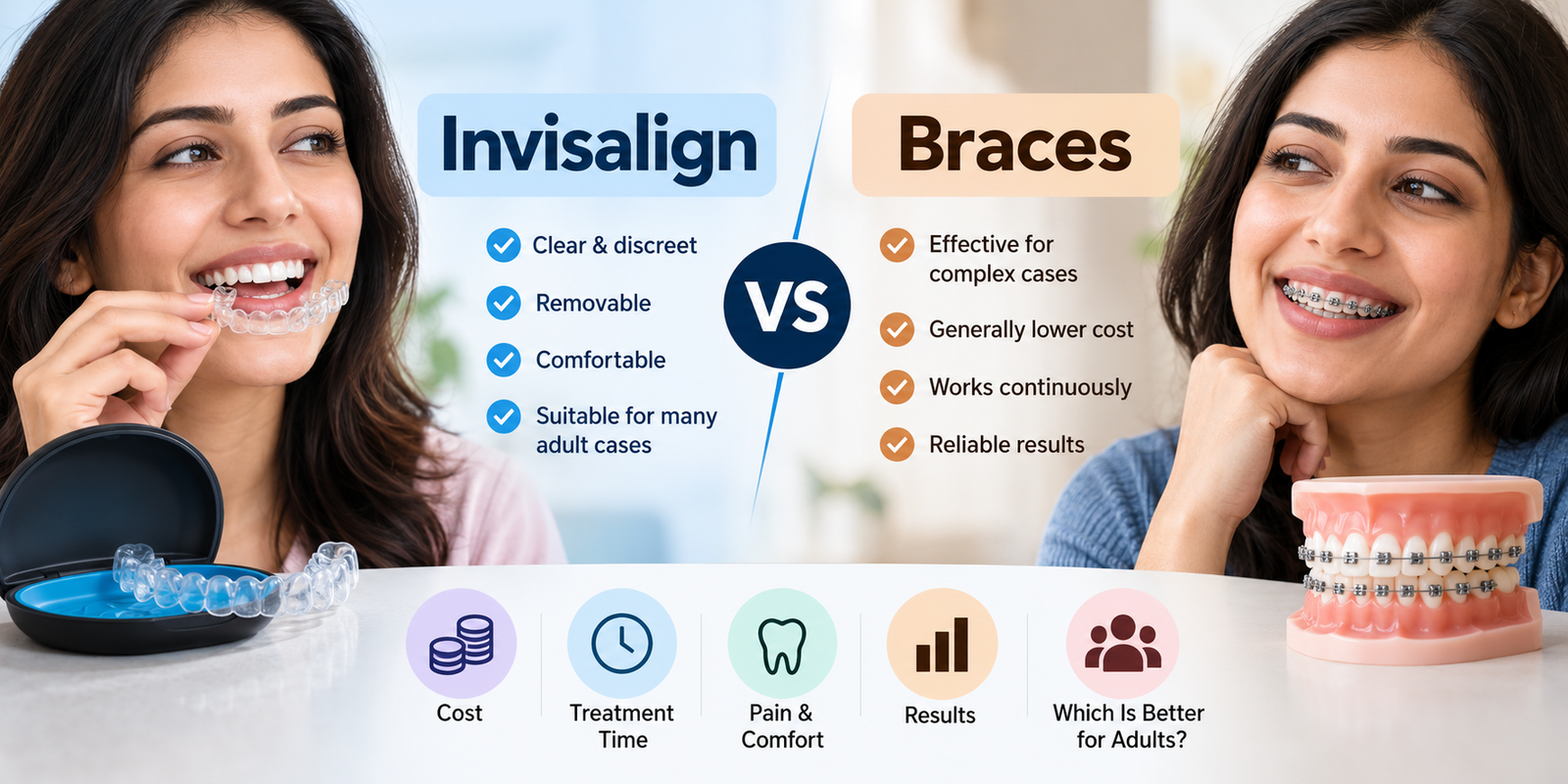
Adults with crooked teeth, gaps between teeth or bite problems often consider orthodontic treatment. Two common options are Invisalign and traditional braces. Both treatments help move teeth into better positions, but they differ in appearance, comfort, cost and daily care.
When comparing Invisalign vs braces for adults, it is important to understand how each treatment works and which dental problems it can correct. Some adults prefer Invisalign because the aligners are clear and removable. Others choose metal braces because they cost less and can be used for many complex alignment problems.
This guide explains the differences between Invisalign and braces, including their cost in India, treatment time, discomfort and expected results.
What Is the Difference Between Invisalign and Braces?
Invisalign is a brand of clear aligners that uses a series of custom-made, removable plastic trays. These trays fit over the teeth and gradually move them into the planned position. Most patients need to wear their aligners for around 20–22 hours each day.
Traditional braces use brackets attached to the teeth and connected with orthodontic wires. These apply controlled pressure to move teeth over time. Unlike Invisalign, fixed braces cannot be removed by the patient during treatment.
Both treatments are used to correct crowded teeth, gaps and certain bite problems. However, treatment suitability depends on the condition of the teeth, gums and jaw.
Invisalign vs Braces: Quick Comparison
| Feature | Invisalign | Metal braces |
| Appearance | Clear, less noticeable | Visible brackets |
| Removable | Yes | No |
| Cost | Usually higher | Usually lower |
| Comfort | Temporary pressure | Pressure and possible irritation |
| Eating | Remove for meals | Food restrictions |
| Cleaning | Removable trays | Clean around brackets |
| Complex cases | Many, not all | Often preferred |
| Wear | Typically 20–22 hours/day | Fixed continuously |
The choice between braces and clear aligners depends on proper diagnosis, treatment goals and patient needs.
Invisalign vs Braces Cost in India
Cost is an important factor for adults planning orthodontic treatment. In India, Invisalign is generally more expensive than traditional metal braces. However, the final price depends on the condition of the teeth, treatment complexity, location and clinic.
How Much Does Invisalign Cost in India?
Invisalign treatment in India may cost approximately ₹1,00,000 to ₹3,00,000 or more. The price depends on the number of aligners, severity of crowding or spacing, treatment duration, orthodontist’s plan and whether additional refinement trays are required.
Invisalign is a specific brand. Other clear aligner brands may cost less, depending on their products and treatment plans.
How Much Do Braces Cost in India?
Traditional metal braces generally cost less than Invisalign. These are broad illustrative ranges, not fixed clinic prices:
| Treatment | Approximate Indian cost |
| Metal braces | ₹25,000–₹80,000 |
| Ceramic braces | ₹40,000–₹90,000 |
| Clear aligners (various brands) | ₹60,000–₹2,50,000 |
| Invisalign | ₹1,00,000–₹3,00,000+ |
The final quote may include or exclude scans, X-rays, extractions, appointments and retainers. For adults comparing braces vs Invisalign cost in India, metal braces are often more budget-friendly.
Which Is More Painful: Invisalign or Braces?
Both Invisalign and braces can cause temporary discomfort because they gradually move teeth.
Pain During Invisalign Treatment
People using Invisalign may feel pressure or tightness when starting treatment or switching to a new aligner. Discomfort is usually temporary. Smooth plastic trays avoid metal brackets and wires, although aligner edges or attachments may still irritate the mouth.
Pain During Braces Treatment
Metal braces can cause soreness after fitting or adjustment. Some patients experience irritation inside the cheeks or lips from brackets and wires. Orthodontic wax and recommended oral care can help.
Invisalign may feel more comfortable for some adults, but neither treatment is pain-free. Persistent or severe pain should be assessed by the treating orthodontist.
Invisalign vs Braces Results: Which Works Better?
Both treatments can produce good teeth-straightening results when planned and monitored correctly. The key difference is the type and complexity of movements each can manage.
When Invisalign May Be Suitable
Invisalign may be considered for mild to moderate crowding, small gaps, certain bite problems, teeth that have shifted after previous treatment and other alignment issues suitable for removable aligners. Some complex movements may also be possible with attachments or additional techniques.
When Traditional Braces May Be Suitable
Braces may be recommended for severe crowding, difficult tooth rotations, complex bite problems, significant tooth movement or when consistent aligner wear is unlikely. Fixed braces work continuously because they remain attached.
The better treatment is not always the more expensive one. An orthodontist should assess tooth alignment, bite and oral health before recommending treatment.
Invisalign vs Braces Treatment Time: Which Is Faster?
Treatment duration depends on complexity, tooth movement required and how well the patient follows the plan. Selected mild Invisalign cases may finish in several months, while complex cases can take 18–24 months or longer. Traditional braces often require around 12–24 months, although some cases take less or more time.
Invisalign is not automatically faster. Severe misalignment, missed appointments, inconsistent aligner wear and additional corrections can extend treatment. An orthodontic assessment provides the most useful personal estimate.
Clear Aligners vs Braces for Adults: Which Is Easier to Maintain?
Maintaining Invisalign Aligners
Clear aligners are generally removed before food or drinks other than plain water. Patients should clean teeth before reinserting trays and clean aligners regularly. Removability makes brushing and flossing easier, but patients must meet the prescribed wear time.
Maintaining Metal Braces
Braces remain in place during meals and brushing. Patients must clean carefully around brackets and wires and may need to avoid hard, sticky or chewy foods to prevent damage. Both treatments require regular checkups and good oral hygiene.
Are Invisalign Aligners Better Than Braces for Working Adults?
Many working adults value a treatment that fits their routine. Invisalign is less noticeable and can be removed for meals, although it requires consistent wear and cleaning. Fixed braces suit adults who prefer not to manage removable trays. The choice depends on dental needs, lifestyle and budget.
Can Adults Get Invisalign or Braces After 30 or 40?
Yes. Orthodontic treatment is not limited to teenagers. Adults in their 30s, 40s or older may qualify if teeth, gums and supporting bone are healthy enough. Before treatment, a dentist may check for gum disease, decay, existing dental work and bone support. Dental problems may need attention first.
Do Invisalign and Braces Give Permanent Results?
Teeth may gradually move after either orthodontic treatment. Retainers help maintain the new positions. Patients should follow their orthodontist’s retainer instructions even after their teeth appear straight.
Invisalign or Braces: Which Is Better for Adults?
There is no single best treatment for every adult. Invisalign may suit adults who prefer discreet removable trays and can follow wear instructions. Traditional braces may be preferred for complex problems, fixed treatment or a generally lower cost. Examination of the teeth, bite and gums is essential.
Conclusion
The comparison between Invisalign vs braces for adults involves more than appearance. Invisalign offers clear removable aligners, while braces use fixed appliances and can manage a wide range of orthodontic problems. Both require regular follow-ups, oral hygiene and retainers. Adults considering either option should consult a qualified orthodontist.
Frequently Asked Questions About Invisalign vs Braces
Is Invisalign better than braces for adults?
Invisalign can suit adults wanting less visible treatment with cases manageable by clear aligners. Braces may be better for complex cases. An orthodontic assessment is essential.
Which is cheaper, Invisalign or braces in India?
Metal braces generally cost less. Indicative metal braces prices are ₹25,000–₹80,000, versus ₹1,00,000–₹3,00,000+ for Invisalign.
Which is more painful, Invisalign or metal braces?
Both may cause temporary soreness. Invisalign can cause pressure after a tray change; braces can cause soreness and irritation from wires and brackets.
Can Invisalign fix crowded teeth in adults?
Yes, it can treat many crowded-teeth cases, but severe crowding may need braces or additional procedures.
How long does Invisalign take compared to braces?
Selected mild aligner cases may take several months. Braces often take 12–24 months. Individual treatment times vary.
Can adults above 40 get Invisalign?
Yes, provided the teeth, gums and supporting bone are suitable for orthodontic movement.
Are clear aligners as effective as braces?
They can be effective for many cases, while braces may offer advantages for selected complex tooth movements.
Can patients eat normally with Invisalign?
They can generally eat after removing trays and should clean their teeth before putting them back in.
Do teeth move back after Invisalign or braces?
They may shift. Wearing retainers as prescribed helps preserve results.
Which is the best teeth-straightening option for adults?
The best choice depends on alignment, bite, oral health, routine and cost, as evaluated by an orthodontist.