
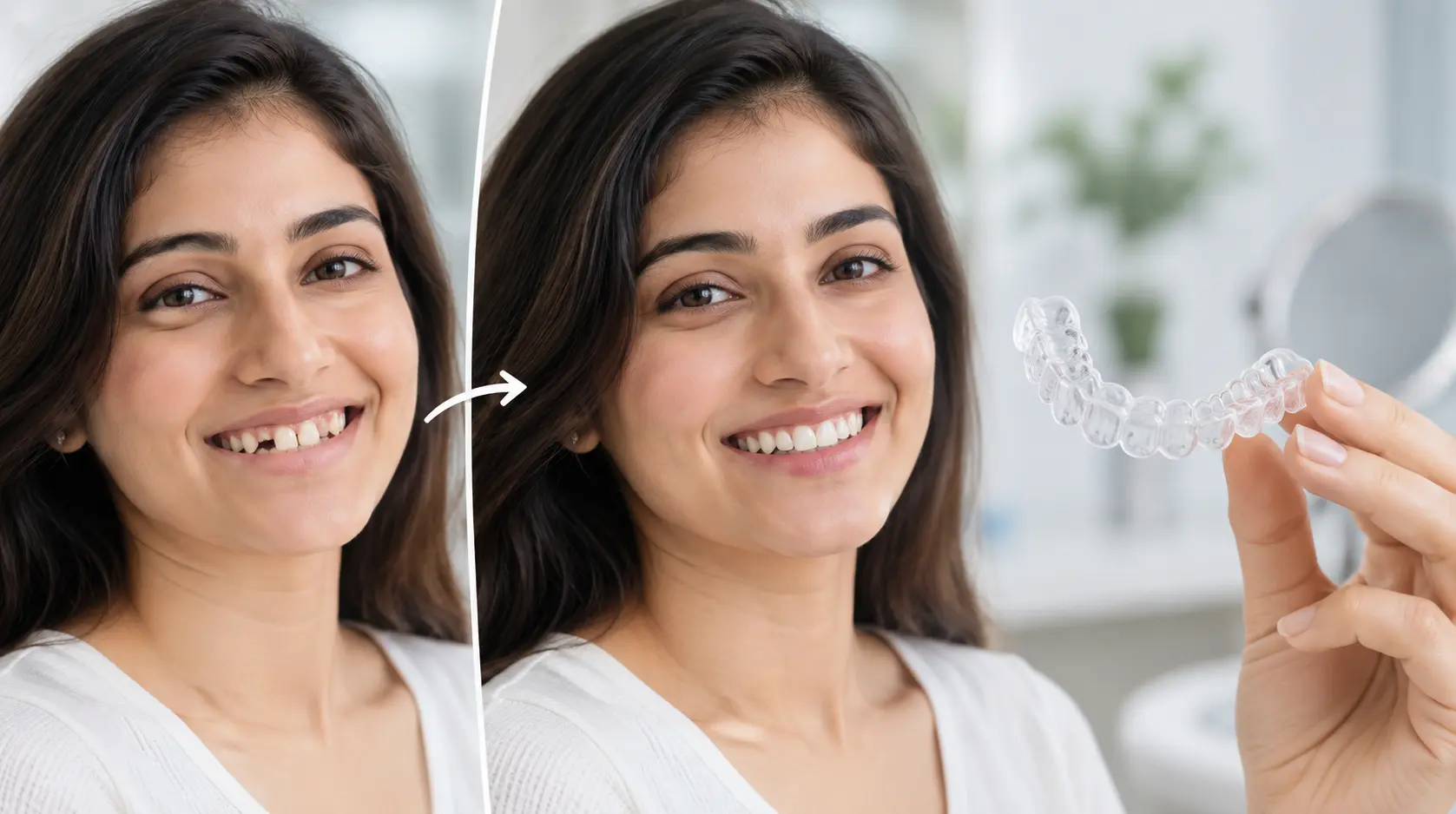
Here is the short answer to what most people want to know: Yes, Invisalign can straighten many crooked or misaligned teeth, but not every case. Suitability depends on the type of misalignment, how severe it is, and whether your bite needs correcting at the same time.
If a crooked teeth smile is the first thing you notice in your own photos, you are not alone. Overlapping front teeth, a tooth that sits slightly behind the others, or crowding that has slowly worsened over the years are among the most common reasons adults visit a dental clinic.
Below is a straightforward look at why teeth end up crooked, what your treatment options are, and how to work out whether clear aligners fit your situation.
What Causes Crooked Teeth?
Crooked teeth usually come down to space. When the jaw doesn’t have enough room for every tooth to sit in line, teeth rotate, tilt or overlap.
Common causes include:
- Genetics. Jaw size and tooth size are inherited, and a small jaw with large teeth leads to crowding.
- Lack of space in the jaw, which forces teeth to overlap as they come through.
- Early loss of baby teeth, which lets neighbouring teeth drift into the gap before the adult tooth arrives.
- Childhood oral habits such as prolonged thumb sucking or extended dummy use.
- Missing teeth, which allow the remaining teeth to shift over time.
- Natural tooth movement with age. Teeth continue to move slowly throughout life, which is why some people see crowding return years after braces.
- Injury to the teeth or jaw.
Most cases involve more than one factor. The cause matters less than the current position of your teeth, which is what treatment is planned around.
Can Crooked Teeth Affect Your Smile?
Yes, in a few ways. The most obvious is appearance. Crowded or overlapping teeth affect how even a smile looks, and misaligned front teeth can make a smile look asymmetrical even when everything else is healthy.
Beyond appearance, misaligned teeth can:
- Make cleaning harder. Tightly overlapping teeth trap plaque in places a brush struggles to reach, which raises the risk of decay and gum problems in those spots.
- Affect the bite in some cases. Where crowding is linked to an overbite, underbite or crossbite, chewing can be uneven and some teeth may wear faster than others.
- Affect confidence. Many patients say they cover their mouth when laughing or choose which side to face in photos.
It is worth being clear about one thing: crooked teeth do not automatically cause dental problems. Plenty of people have mildly crooked teeth, clean them well and never have an issue. Treatment is a choice, not an obligation, and a good dentist will tell you honestly whether yours is a cosmetic concern or a functional one.
How Can You Fix a Crooked Teeth Smile?
Crooked teeth are corrected by moving them into a new position, and there are several ways to do that. Clear aligners such as Invisalign, traditional metal braces, ceramic braces and lingual braces all move teeth. Certain cosmetic treatments can improve appearance in selected cases, but they do not move teeth. The right option depends on the severity of the misalignment.
The main routes are:
- Clear aligners / Invisalign. Removable transparent trays that move teeth in planned stages. Suitable for many mild to moderate cases.
- Traditional braces. Fixed metal brackets and wires. The most versatile option, especially for complex movement and bite correction.
- Ceramic braces. The same mechanism as metal braces, with tooth-coloured brackets that are far less noticeable.
- Lingual braces. Fixed to the back of the teeth so they are hidden from the front, though they take some getting used to.
- Cosmetic treatments such as bonding or veneers. These reshape or cover the visible surface of a tooth. They can help with a single chipped or slightly uneven tooth, but they leave the actual tooth position unchanged.
That last distinction is the one patients most often miss. Covering a crooked tooth is not the same as correcting it. If you want a wider comparison of the non-metal routes, our guide on how to align teeth without braces covers each option in more detail.
Can Invisalign Fix Crooked Teeth?
In many suitable cases, yes. Invisalign uses a series of custom-made clear aligners to move crooked or crowded teeth into planned positions, a small amount at a time. Whether it suits you depends on how much movement your teeth need and whether your bite needs work alongside them.
Here is how the treatment works in practice.
Every case starts with a digital 3D scan of your teeth. That scan is used to plan the full sequence of tooth movement before any aligner is manufactured, and you can usually see a simulation of the projected result before you commit to anything.
You then receive a series of transparent aligners. Each one is shaped slightly differently from the last, so it applies gentle pressure that guides specific teeth a short distance. You wear each aligner for roughly 8 to 10 days, then move to the next in the series. Progress is checked at follow-up appointments so your orthodontist can confirm the teeth are tracking to plan.
Two features set clear aligners apart from fixed braces:
- They are removable. You take them out to eat, brush and floss, so there are no food restrictions and your cleaning routine stays the same.
- They are difficult to notice. Invisible braces sit close to the teeth with no brackets or wires, which is why most adults ask about them first.
Clear aligners for crooked teeth can be an option in cases involving crowded or overlapping teeth, crooked front teeth, gaps between teeth, and certain overbites, underbites and crossbites. They are not suitable for everything. Cases needing large movements, significant rotation or jaw correction are usually better handled with fixed braces.
There is one factor entirely in the patient’s hands: wear time. Aligners work only while they are in your mouth, and the standard instruction is 20 to 22 hours a day. Treatment slows down when they are left out.
If you want to see how a case is planned and monitored from the first scan onward, our page on Invisalign for crooked teeth sets out each stage. Patients from Magarpatta, Amanora, Hadapsar, Kharadi and Koregaon Park regularly come in for a scan simply to find out whether aligners are an option for them.
Invisalign vs Traditional Braces for Crooked Teeth
| Feature | Invisalign / Clear Aligners | Traditional Braces |
|---|---|---|
| Appearance | Transparent, sits close to the teeth | Metal brackets and wires, clearly visible |
| Removable | Yes, taken out to eat and clean | No, fixed until treatment ends |
| Eating | No food restrictions | Hard and sticky foods to be avoided |
| Cleaning | Normal brushing and flossing with aligners out | Cleaning around brackets takes more effort |
| Visibility | Hard to notice in conversation | Noticeable |
| Maintenance | Aligners changed on schedule, plus periodic check-ups | Regular adjustment appointments |
| Suitability | Mild to moderate cases, and certain complex ones | Wide range, including complex bite and movement cases |
Neither option is better across the board. Braces give the orthodontist more control and keep working whether or not the patient remembers anything. Aligners offer comfort and discretion, but depend on being worn as instructed. The right choice comes down to what your teeth actually need.
How Long Does It Take to Straighten Crooked Teeth?
Treatment time varies, and it depends on:
- how severe the crowding or misalignment is
- how far the teeth need to move
- whether the bite needs correcting too
- the overall complexity of the case
- how consistently removable aligners are worn
- the individual treatment plan
At Bespoke Dental Clinic, mild aligner cases are typically planned over roughly 6 to 8 months, and moderate cases over 12 to 18 months. Complex cases can take longer. These are planning ranges, not guarantees. Your exact duration is confirmed after the digital scan, once the full movement plan is mapped out.
Is Invisalign Suitable for Everyone With Crooked Teeth?
No. Clear aligners suit many patients, but not all of them. Suitability is assessed on:
- the type of misalignment, such as crowding, rotation, gaps or bite problems
- how severe the misalignment is
- current tooth position and how far each tooth must travel
- the health of your teeth and gums
- whether jaw growth is complete, which usually means adults and older teenagers
- your treatment goals
- your ability to wear aligners for 20 to 22 hours a day
Active decay or gum disease is usually treated before orthodontic treatment begins. And where a case involves significant bite correction or large movements, fixed braces may deliver a better result. A clinic worth trusting will tell you that rather than fit you to the treatment you walked in asking for.
Which Crooked Teeth Treatment Is Right for You?
1. Mild to moderate crowding or crooked front teeth?
Clear aligners are often an option for suitable patients.
2. More complex orthodontic problems
Traditional, ceramic or lingual braces may be recommended for better control.
3. Mainly cosmetic concerns, with a healthy bite
Bonding or veneers may improve appearance, though they do not move teeth.
4. Not sure which applies to you
An orthodontic assessment with a scan is the practical starting point. It takes one appointment and gives you a definite answer.
Conclusion
Crooked teeth can usually be treated, and you have more than one route to choose from. Clear aligners, traditional braces, ceramic braces and lingual braces all produce genuine tooth movement, while cosmetic treatments change appearance without changing position.
Invisalign is a realistic option for many people with crooked, crowded or overlapping teeth, but it is not right for everyone, and no honest answer about your own teeth can be given without an examination and a scan.
If a crooked teeth smile is something you would like to correct, you can read more about Invisalign treatment at Bespoke Dental Clinic in Pune and book an assessment to find out whether clear aligners suit your case.
Frequently Asked Questions
1. Can crooked teeth be fixed?
Yes, in most cases. Orthodontic treatment moves teeth into better alignment, and the method depends on how severe the misalignment is.
2. How can I straighten crooked teeth?
Through orthodontic treatment: clear aligners, traditional braces, ceramic braces or lingual braces. All of these move teeth, unlike cosmetic treatments, which only change appearance.
3. Is Invisalign good for crowded teeth?
It can be, for mild to moderate crowding. Severe crowding may need fixed braces, and sometimes space has to be created before alignment can begin.
4. Invisalign fix crooked front teeth?
Often, yes. Front teeth are among the most commonly treated with clear aligners, though the plan still depends on the rest of your bite.
5. How long does it take to straighten crooked teeth?
It varies by case. Mild cases at our clinic are generally planned over about 6 to 8 months and moderate cases over 12 to 18 months, with complex cases taking longer.
6. Are clear aligners better than traditional braces?
Not universally. Aligners are more comfortable and discreet. Braces offer more control and do not rely on patient compliance. Each suits different cases.
7. Can adults straighten crooked teeth with Invisalign?
Yes. Adults make up the largest group in clear aligner treatment, and there is no upper age limit provided the teeth and gums are healthy.