
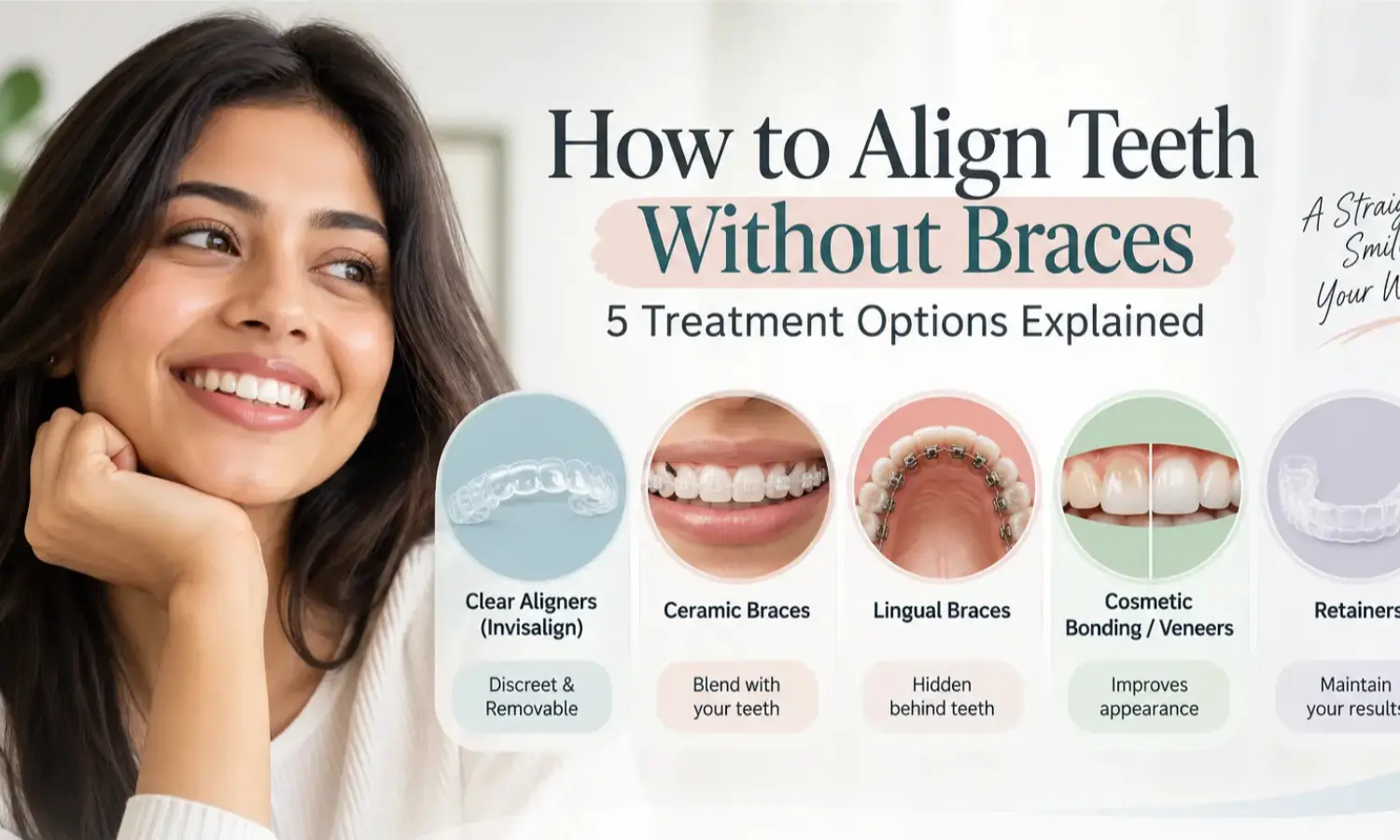
Most people who ask how to align teeth without braces are not avoiding treatment. They are avoiding metal. They have crowded teeth, a gap they’ve never liked, or a bite that has shifted over the years, and they don’t want two years of brackets and wires showing in every photo and meeting.
The good news is that traditional braces are no longer the only route. Clear aligners, ceramic braces, lingual braces and certain cosmetic treatments can all improve the look of your teeth, and some of them can genuinely move teeth.
That last point matters more than anything else in this article. There is a real difference between treatments that move your teeth into a new position and treatments that only change how your teeth look. Mixing the two up is the most common mistake patients make. Below, we’ve kept them clearly separate.
Can You Align Teeth Without Traditional Braces?
Yes, in many cases. Depending on how your teeth are positioned, the options include clear aligners such as Invisalign, ceramic braces, lingual braces, and certain cosmetic treatments. Clear aligners are the only fully removable choice. Severe crowding, large gaps and complex bite problems often still need traditional braces for proper control.
So the honest answer is: sometimes yes, sometimes no. It depends on how far your teeth need to travel and whether your bite needs correcting alongside them. A short examination and an X-ray usually settle the question quickly.
What Are the Options for Straightening Teeth Without Braces?
Here are the five realistic alternatives, and what each one can and cannot do.
1. Clear Aligners / Invisalign
Clear aligners are thin, transparent, custom-made trays that fit over your teeth. You wear them almost all day and swap them for the next tray in the series every week or so. Each tray is shaped slightly differently from the one before it, so your teeth are guided a small distance at a time. That gradual tooth movement is what produces the final result.
Invisalign is the best-known clear aligner system. Treatment starts with a digital 3D scan of your teeth, which is used to plan every stage of movement before a single aligner is made. You can usually see a simulation of the projected outcome before you commit.
Two things make aligners different from every other option on this list:
- They are removable. You take them out to eat, brush and floss. No food restrictions, and your cleaning routine stays exactly as it is.
- They are hard to notice. Transparent aligners sit close to the teeth without brackets or wires, which is why many adults choose them over fixed braces.
Aligners can be suitable for crooked teeth, teeth crowding, gaps between teeth, and certain overbites, underbites and crossbites. They are not suitable for everything. Cases needing large movements, tooth rotation beyond a certain point, or significant jaw correction may be better handled with fixed braces or other orthodontic treatment.
There is one condition that decides most outcomes: wear time. Aligners only work while they are in your mouth. The usual instruction is 20 to 22 hours a day, removing them only for meals and cleaning. Patients who leave them out for long stretches see their treatment slow down or stop tracking to plan.
If you’re considering Invisalign in Pune, see how Bespoke Dental Clinic plans and monitors clear aligner treatment. Patients around Magarpatta, Amanora and Hadapsar can have a scan done to check whether their case is suitable before deciding anything.
2. Ceramic Braces
Ceramic braces work the same way as metal braces. Brackets are fixed to the teeth and connected by a wire that applies steady pressure. The difference is the material: the brackets are tooth-coloured or clear, so they blend in far better than metal.
They are still fixed braces. You cannot remove them, food restrictions still apply, and cleaning takes more effort. But they offer the control of traditional braces with much less visibility, which suits patients whose cases are too complex for aligners.
They are also slightly more fragile than metal brackets and can stain if not cleaned well.
3. Lingual Braces
Lingual braces are fixed to the back surfaces of the teeth, facing the tongue. From the front, they are essentially invisible.
They can handle a wide range of cases, but they come with trade-offs. They take time to get used to, may affect speech for the first few weeks, and are harder to clean because of where they sit. They are also more technique-sensitive to fit and adjust, so not every practice offers them. For patients whose priority is complete invisibility with the control of fixed braces, they remain a genuine option — and worth discussing during an orthodontic consultation in Pune.
4. Cosmetic Treatments: Bonding and Veneers
Dental bonding uses tooth-coloured composite material to reshape a tooth. Veneers are thin shells fixed to the front of the teeth. Both can make small gaps, chips and slightly uneven teeth look straighter, often in one or two visits.
Here is the important part: neither of these moves your teeth. They change the surface you see. The root, the bite and the underlying position stay exactly where they were.
For a single chipped or slightly rotated front tooth, cosmetic dentistry can be a sensible answer. For genuine crowding or a bite problem, covering the teeth does not fix the cause, and in some cases it involves removing healthy tooth structure for a purely cosmetic result. It is worth being clear about which of the two you actually need.
5. Retainers and Minor Tooth Movement
Retainers hold teeth in their finished position after orthodontic treatment. That is their main job, and they do it well.
Some patients whose teeth have shifted slightly after previous braces can be treated with a retainer or a short aligner-based plan. But retainers are not a substitute for orthodontic treatment in an untreated case. They maintain position; they are not designed to create it.
Can Invisalign Fix Crooked or Misaligned Teeth?
In many suitable cases, yes. Clear aligners can address crooked teeth, crowded teeth and gaps, and they can be used for certain overbites, underbites and crossbites. Whether they are right for you depends on how much movement your teeth need and whether your bite needs correcting at the same time.
Broadly:
- Crooked or crowded teeth: commonly treatable when the crowding is mild to moderate.
- Gaps between teeth: often treatable, depending on the size and cause of the gap.
- Overbite, underbite, crossbite: treatable in certain cases. More significant bite problems may need fixed braces or a combined approach.
No dentist can tell you which group you fall into from a photo. It takes an examination, a scan and usually an X-ray.
Invisalign vs Traditional Braces: What’s the Difference?
| Feature | Invisalign / Clear Aligners | Traditional Braces |
|---|---|---|
| Appearance | Transparent, sits close to the teeth | Metal brackets and wires, clearly visible |
| Removable | Yes, taken out to eat and clean | No, fixed until treatment ends |
| Eating | No food restrictions | Hard and sticky foods to be avoided |
| Cleaning | Normal brushing and flossing with aligners out | Cleaning around brackets takes more time |
| Visibility | Difficult to notice in conversation | Noticeable |
| Maintenance | Trays changed on schedule, plus periodic check-ups | Regular adjustment appointments |
| Suitability | Mild to moderate cases, and certain complex ones | Wide range, including complex bite and movement cases |
Neither is universally better. Braces give the orthodontist more control and don’t depend on the patient remembering anything. Aligners give comfort and discretion, but only work if worn as instructed.
How Long Does It Take to Align Teeth Without Braces?
There is no fixed answer, because duration depends on:
- how severe the misalignment is
- how far the teeth need to move
- whether the bite needs correcting too
- the overall complexity of the case
- how consistently you wear removable aligners
- your individual treatment plan
At Bespoke Dental Clinic, mild aligner cases are typically planned over roughly 6 to 8 months and moderate cases over 12 to 18 months. Complex cases can take longer. These are planning ranges rather than promises. Your exact duration is confirmed after your digital scan, when the full movement plan is mapped out.
Who Is a Good Candidate for Clear Aligners?
Aligner treatment tends to suit people who have:
- mild to moderate crowding or crooked teeth
- gaps that are within a treatable range
- certain bite issues rather than significant jaw discrepancies
- healthy teeth and gums, with no untreated decay or gum disease
- completed jaw growth, which usually means adults and older teenagers
- the discipline to wear aligners 20 to 22 hours a day
Patients with active gum disease or decay are usually treated for that first. And some cases genuinely do better with fixed braces. A good clinic will tell you that rather than sell you the aligner.
How Do You Choose the Right Treatment for Crooked Teeth?
A rough guide to where you might fall:
- Mild crowding, small gaps, slightly crooked teeth: clear aligners are often an option.
- Significant crowding, notable bite problems, complex movement: traditional, ceramic or lingual braces may be recommended.
- A chipped, worn or slightly uneven tooth, with the bite otherwise fine: cosmetic treatment may be enough.
- Teeth that have shifted slightly since previous braces: a retainer or short aligner plan may be considered.
This is a way to frame the conversation, not a diagnosis. Only an examination can tell you which one applies.
Conclusion
Teeth can often be aligned without traditional braces. Clear aligners, ceramic braces and lingual braces all move teeth. Cosmetic treatments change appearance only, and retainers hold position rather than create it. Which one fits depends entirely on your own teeth, your bite and how much movement is needed, and that can only be determined by a dental examination and scan.
If you’re considering straightening your teeth without traditional metal braces, you can read more about Invisalign treatment at Bespoke Dental Clinic and book a consultation to find out whether clear aligners suit your case. We see patients from across Pune, including Margarpatta, Amanora, Kharadi, Hadapsar and Koregaon Park.
Frequently Asked Questions
1. Can you straighten teeth without braces?
Yes, in many cases. Clear aligners, ceramic braces and lingual braces are all alternatives to traditional metal braces. Some cases still need conventional braces for adequate control.
2. What is the best way to align teeth without braces?
There is no single best method. For mild to moderate misalignment, clear aligners are usually the most popular alternative because they are removable and hard to notice. The right choice depends on your teeth and bite.
3. Can clear aligners fix gaps between teeth?
Often, yes. Aligners can close many gaps by moving the teeth closer together. Very large gaps, or gaps caused by missing teeth, may need a different approach.
4. How long does it take to straighten teeth without braces?
It varies by case. Mild cases at our clinic are generally planned over about 6 to 8 months and moderate cases over 12 to 18 months, with complex cases taking longer.
5. Are clear aligners better than traditional braces?
Not universally. Aligners are more comfortable and discreet, while braces offer greater control and don’t rely on the patient wearing anything. Each suits different cases.
6. Can adults straighten their teeth without braces?
Yes. Adults are the largest group using clear aligner treatment, and there is no upper age limit as long as the teeth and gums are healthy.
7. Can Invisalign fix an overbite?
It can help with certain overbites. More significant bite problems may need fixed braces or a combined approach, so this is assessed case by case.
8. Do veneers count as teeth straightening?
No. Veneers change how teeth look but do not move them. They are a cosmetic treatment, not orthodontic treatment.