
Key Takeaway
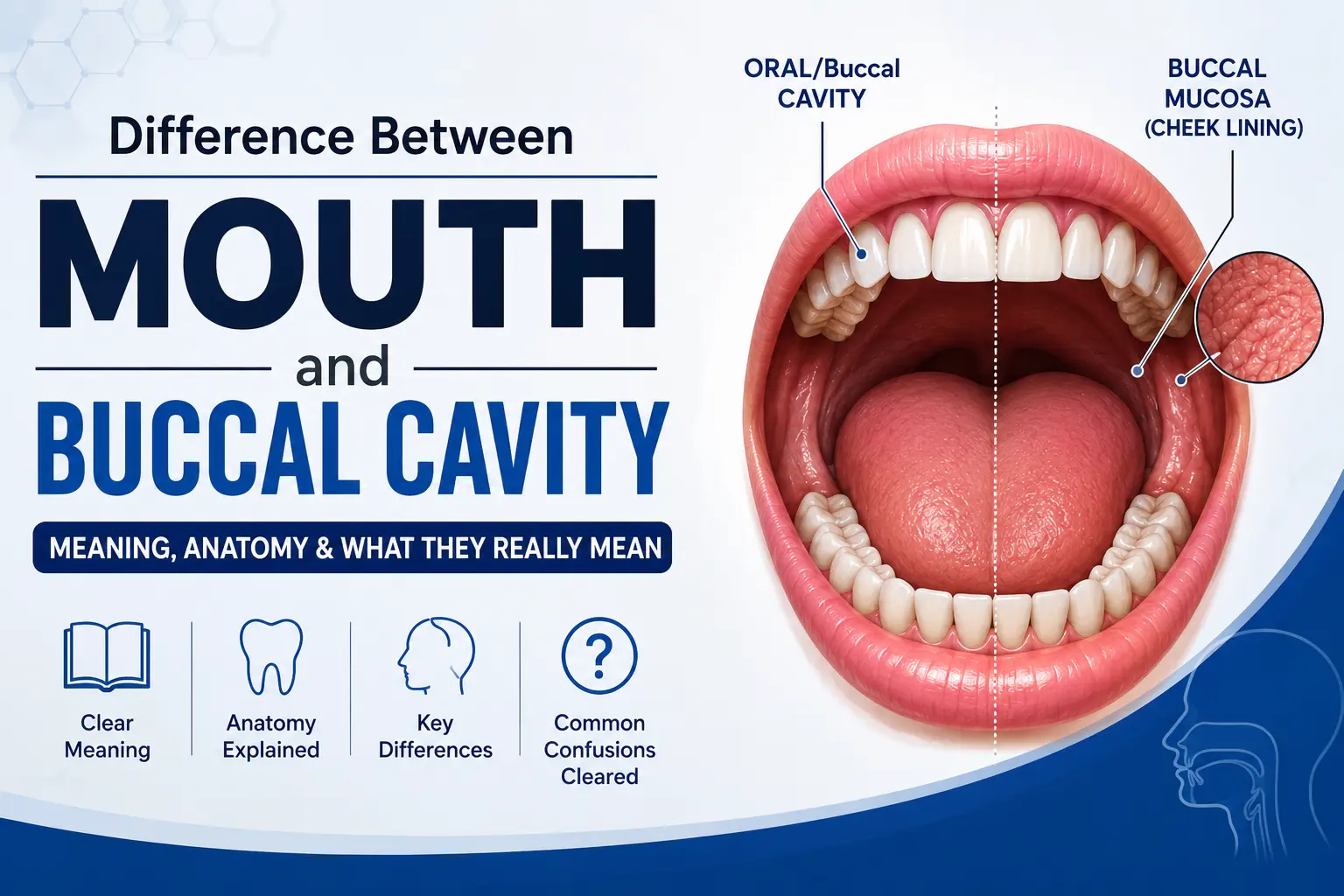
The terms mouth, oral cavity, and buccal cavity are often used interchangeably in general and educational contexts to describe the same space. However, “buccal” specifically means relating to the cheek, and “buccal mucosa” refers only to the inner cheek lining, not the entire mouth. The difference between mouth and buccal cavity is primarily one of terminology and context, not anatomy.
Introduction
If you have ever searched for something related to dental health or oral anatomy, you have probably come across the terms “mouth,” “oral cavity,” “buccal cavity,” and “buccal mucosa” used in ways that seem to overlap, or sometimes contradict each other. One source calls “buccal cavity” the same as the mouth. Another describes it as something more specific. A third mixes it up with “buccal mucosa.”
It is one of the most common terminology questions in dental and biology content, and the confusion is completely justified. The difference between mouth and buccal cavity is not a difference in anatomy. It is a difference in how different sources use these words.
Here is the direct answer: mouth, oral cavity, and buccal cavity generally refer to the same anatomical space. “Mouth” is the everyday word. “Oral cavity” is the standard anatomical and dental term. “Buccal cavity” is a term used in biology and educational material to mean the same thing. However, the word “buccal” on its own means relating to the cheek, and “buccal mucosa” refers specifically to the inner cheek lining, which is just one part of the oral cavity.
That clears up the core confusion. Now let us look at each term more closely and understand why this mix-up happens so often.
Difference Between Mouth and Buccal Cavity
The most straightforward way to understand the difference between mouth and buccal cavity is to look at it from three angles: what each term covers, who uses it, and when the distinction actually matters.
In scope, they overlap almost entirely. Both “mouth” and “buccal cavity” are used to describe the same physical space: the area bounded by the lips, cheeks, palate, floor of the mouth, and the throat at the back. This space contains the teeth, tongue, gums, salivary glands, and the mucosal lining. When a biology textbook says “the buccal cavity is where digestion begins,” it is describing exactly the same space you would point to if someone asked you to open your mouth.
In usage, they belong to different worlds. “Mouth” is the word you use in everyday conversation. “Buccal cavity” is the term you encounter in biology textbooks, exam papers, and educational content. “Oral cavity” is the term your dentist, doctor, or surgeon uses. All three point to the same anatomy, but each one signals a different context. You would never hear a dentist say “open your buccal cavity,” just as you would never see a biology paper use the phrase “the mouth is the first organ of the alimentary canal.”
The distinction matters when “buccal” is used in its clinical sense. This is the part most sources fail to explain clearly. The word “buccal” does not always mean the whole mouth. In dentistry and clinical anatomy, “buccal” specifically means relating to the cheek. So while “buccal cavity” as a standalone phrase usually refers to the entire mouth, terms like “buccal mucosa” (inner cheek lining), “buccal surface” (the cheek-facing side of a tooth), and “buccal vestibule” (the space between the cheek and the gums) are all cheek-specific. They do not describe the whole oral cavity.
Here is how the four key terms relate to each other
| Term | What It Refers To | Where You Will See It |
|---|---|---|
| Mouth | The entire mouth | Everyday language |
| Oral cavity | The internal space of the mouth | Dentistry, medicine, anatomy |
| Buccal cavity | The mouth (used as a synonym) | Biology textbooks, general education |
| Buccal mucosa | Only the inner cheek lining | Clinical dentistry, oral pathology |
This is the real difference between mouth and buccal cavity. It is not that they describe different anatomical spaces. It is that the word “buccal” shifts meaning depending on whether it is being used as a general label for the mouth or as a precise anatomical descriptor for cheek-related structures. Once that distinction clicks, the conflicting definitions you find online stop being contradictions and start making sense.
Why Do Different Sources Give Different Answers?
This is worth addressing directly, because it is the root cause of most of the confusion online.
Biology and general education sources use “buccal cavity” and “oral cavity” interchangeably. This is standard practice in CBSE, ICSE, and state board textbooks, undergraduate biology, and general science writing. In these contexts, there is no distinction between the two terms.
Clinical dentistry and anatomy sources reserve “buccal” for cheek-specific structures. A dentist will say “oral cavity” when referring to the entire mouth, but will use “buccal” when discussing the buccal mucosa, the buccal vestibule, or the buccal surface of a tooth.
If a source says buccal cavity and oral cavity are the same, it is speaking in general terms. If a source says “buccal” refers specifically to the cheek, it is using precise anatomical language. Both are accurate within their own context. The problem is that most online articles do not explain this, which leaves readers more confused than when they started.
Buccal Cavity vs Oral Cavity: Is There a Difference?
The difference between oral cavity and buccal cavity follows the same pattern described above.
In most educational material, particularly in biology, these two terms are used interchangeably. A sentence like “the buccal cavity is where digestion begins” means exactly the same as “the oral cavity is where digestion begins.”
In more detailed anatomical discussions, “oral cavity” is the standard, universally accepted clinical term. It is the term used in dental records, medical reports, surgical notes, and anatomy references. “Buccal cavity” is not commonly used in these clinical settings.
Where the distinction becomes more relevant is when discussing sub-regions of the oral cavity:
- Oral vestibule: the narrow space between the teeth/gums and the inner cheeks/lips. On the cheek side, this is sometimes called the buccal vestibule.
- Oral cavity proper: the larger space inside the dental arches, where the tongue sits.
- Buccal mucosa: the mucosal lining specifically on the inner surface of the cheeks.
So in precise anatomical language, “oral cavity” is the broader and more universally accepted term, while “buccal” describes a specific region within or adjacent to it. In general usage, however, the two terms overlap significantly and can be treated as synonyms.
What Is the Buccal Mucosa and Why Does Your Dentist Examine It?
The buccal mucosa is the soft, moist tissue that lines the inner surface of your cheeks. If you run your tongue along the inside of your cheek, you are feeling your buccal mucosa.
It extends from the corners of the lips to the area near the back teeth on each side. It is smooth, flexible, and rich in blood vessels, which is why even a small accidental cheek bite can bleed noticeably.
This tissue matters in dentistry because your dentist examines it during every routine oral check-up. They are looking for:
- Recurring ulcers or sores that may need evaluation if they do not heal within a normal timeframe
- White or red patches that could indicate irritation or other mucosal changes
- Bite marks or friction lines caused by sharp tooth edges, ill-fitting restorations, or habitual cheek biting
- Swelling or textural changes that were not present during previous examinations
This is one of the reasons dental check-ups involve more than just looking at your teeth. A thorough oral examination covers every soft tissue surface inside the mouth, and the buccal mucosa is a key part of that assessment.
Important clarification: The buccal mucosa is not a cavity. It is a tissue lining. It is one component of the oral cavity. Confusing “buccal mucosa” with “buccal cavity” is like confusing the wallpaper with the room.
What Does Your Dentist Actually Examine Inside the Oral Cavity?
Most patients assume a dental check-up is only about teeth. In reality, a systematic oral examination covers the entire oral cavity, and each structure your dentist evaluates connects back to the terminology we have discussed.
Here is what a typical examination includes:
Teeth. Your dentist checks for cavities, cracks, wear, mobility, and the condition of existing restorations like fillings or crowns. When they note the location of a cavity, they may refer to the “buccal surface” (cheek side) or “lingual surface” (tongue side) of a specific tooth.
Gums (gingiva). Healthy gums are firm and pale pink. Your dentist looks for signs of inflammation, bleeding, recession, or pocketing around the teeth, all of which can indicate early or progressing gum disease.
Tongue. The top, underside, and edges of the tongue are examined for any unusual colour changes, coating, swelling, or sores.
Palate. Both the hard palate (the firm front portion of the roof of your mouth) and the soft palate (the flexible back portion) are visually inspected.
Floor of the mouth. The area beneath the tongue is checked, as it contains salivary gland openings and soft tissue that can sometimes show early signs of changes.
Buccal mucosa. As discussed above, the inner cheek lining on both sides is examined for ulcers, patches, irritation, or any textural changes.
Oral vestibule. The narrow space between the teeth/gums and the inner cheeks/lips is also assessed. In anatomical terms, this area is sometimes called the buccal vestibule on the cheek side.
This is why understanding terms like “oral cavity,” “buccal mucosa,” and “buccal surface” is practically useful. It helps you follow along during consultations, understand your dental reports, and communicate more clearly with your dentist about any concerns.
Conclusion
The difference between mouth and buccal cavity comes down to terminology and context, not anatomy. “Mouth” is everyday language, “oral cavity” is the standard dental and medical term, and “buccal cavity” is a synonym used primarily in educational and biology contexts. “Buccal mucosa,” on the other hand, refers specifically to the inner cheek lining and is just one part of the oral cavity.
Understanding how these terms connect to each other is not just academic. It helps you follow your dental consultations more clearly, read your dental reports with confidence, and communicate better with your dentist about what is happening inside your mouth.
If you have questions about your oral health or are due for a comprehensive dental examination. Book a consultation with Dr. Vipul Nawal and Dr. Ishani Mehra Nawal for a thorough, personalised assessment.
Frequently Asked Questions
1. What is the difference between the oral cavity and buccal cavity?
In most educational and general contexts, they refer to the same space: the inside of the mouth. “Oral cavity” is the standard anatomical term used in dentistry and medicine. “Buccal cavity” is commonly used in biology and general science as a synonym.
2. Is the buccal cavity the same as the mouth?
In general usage, yes. “Buccal cavity” is widely used to mean the mouth, especially in educational material. However, “buccal” technically means relating to the cheek, so in precise clinical contexts it carries a narrower meaning.
3. What is another name for the buccal cavity?
The mouth and oral cavity. All three terms are frequently used interchangeably in biology and general science.
4. What is the function of the buccal cavity?
The buccal cavity (mouth) handles ingestion, mechanical digestion through chewing, mixing food with saliva, beginning chemical digestion via salivary enzymes, bolus formation for swallowing, taste perception, and speech.
5. Where is the buccal cavity located?
It is located in the lower part of the face, bounded by the lips in front, cheeks on the sides, the palate above, the floor of the mouth below, and the throat at the back.
6. Is the buccal mucosa the same as the oral cavity?
No. The buccal mucosa is the soft tissue lining specifically on the inner surface of the cheeks. It is one component within the oral cavity, not the entire space.